

The Mattress Organic
by Rhintek LLC
8835c Columbia 100 Pkwy
Columbia, MD 21045
(410) 730-2575
Contact Us
View Larger Map
Core Materials
Steel springs are the most common mattress core material by far. It seems reasonable to assume that springs provide moderate comfort but there are several problems with them:
- There is no way that a purchaser can compare spring mattress quality.
- Every mattress reseller has their own mattress lines, thus you cannot compare prices.
- They can be noisy, and tend to flex the whole bed when one section is compressed (this is great for jumping on, though).
Ask yourself why does a more expensive spring mattress core have layers upon layers of various materials between the springs and the ticking? Is the spring core inherently wrong and need to be adjusted to feel good? Spring mattresses must be especially designed for adjustable, e.g. “hospital” beds, while foam mattresses generally conform to adjustable beds.
Foam cores have been used in mattresses for a long time. The major types are polyurethane, latex, and visco-elastic or memory foam. Foam cores are quiet and are not prone to shaking like spring cores.
Polyurethane foam is the most common and least expensive soft foam product available today. Polyurethane foam is used for a great variety of products where cushioning is desired, from packing cases to pillows and mattress components. Polyurethane foams come in a HR (high resiliency) version that can be used as a box spring replacement. Polyurethane foam has several major shortcomings when used as a mattress core:
- The cell structure is too tight, thus it does not breathe enough. This makes polyurethane feel hot in the summer because of the limited airflow, and cold/clammy in the winter when normal perspiration remains trapped in the mattress. Since people perspire during sleep, it is important to have enough air circulation through the mattress.
- Since polyurethane is a synthetic product there is no natural anti-microbial, anti-fungal, or anti-dust mite protection.
- Life of polyurethane is rather short. After 5 to 10 years some of these foams break down and lose their resiliency, eventually becoming a sticky mess.
- Even though polyurethane foam degrades fairly quickly it does not degrade into biologically benign components. These foams leave a hydrocarbon residue for a long time.
Memory foam, also known as visco-elastic foam, is making a big splash on the mattress market, mainly because of the advertising of the Tempur-Pedic company. Memory foam is a substantial improvement over springs and polyurethane foam in terms of comfort, but why would you want a mattress that retained your impression after you had rolled over? The 10 year lifetime is an improvement over polyurethane foam but most memory foam mattresses are layers (~3in) of actual memory foam on top of one or more layers (~5in) of polyurethane foam. (This structure reminds me of putting a topper on top of a regular mattress.)
The quality and durability of the memory foam is in direct relation to the density of the foam. Generally 5.3 lbs to 5.9 lbs is considered the ideal density to properly support the human body. Cheap memory foams are 2-3 lbs, medium foams are 3-5 lbs, and good quality foams are over 5 lbs. (This weight is for a cube 12 inches on a side.) There are many similar foams coming onto the market. The true visco-elastic, memory foam is heat sensitive. This is part of the “magic” of memory foam's ability to conform to your body as you lie on it. You can test for this property by putting an ice pack on the mattress for a short while — it should become very hard. Of course the down side of this is that if you like to sleep in a cold room... (It is recommended that the room temperature be above 65 deg if you use a memory foam mattress or topper.)
While a good memory foam mattress should provide a good night's sleep, it does not provide the hypoallergenic properties of latex. There have been numerous report of negative reactions to the out-gassing of the visco-elastic foams. And some people don't find it comfortable: "Like sleeping on quicksand" was one description I heard.
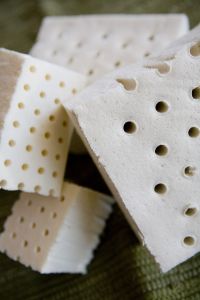
Latex Foam Pieces
Latex foam starts out as the sap of a rubber tree (hevea brasiliensis). After cleaning, purifying, and concentrating, the raw rubber is foamed — whipped with air — and poured into a mold. With the Dunlop process the foam is cured at this stage. With the Talalay process, a lid is put on the mold and the air at the top is vacuumed off, making a more consistent and lighter foam core. The Talalay process also freezes the liquid foam to keep it from settling during the curing process.
Latex foam will slowly oxidize over time (tens of years) and will discolor if left in the sun, but the life of the typical latex mattress core should be well beyond 20 years. I have seen a 48 year old latex foam sample that would still be quite usable as a mattress. Since latex is a totally natural product, all of the original plant defenses are still in place. This makes latex inherently anti-microbial, anti-fungal, and inhospitable to dust mites. While a few people have claimed to have latex allergies, this has actually been shown to be allergic reactions to other materials mixed with the latex in latex gloves and other latex products. There has never been anyone confirmed to be allergic to a properly washed (to remove the mold release agents and excess proteins) 100% natural latex mattress.
The cell structure for latex foam is much more open than polyurethane and other manufactured foams. The openness lets the mattress breathe, keeping you cool in the summer, warm in the winter, and prevents perspiration from building up in the mattress. Latex foam responds immediately to changes in pressure, conforming to your body as you turn in your sleep. The feel of the support provided by latex foam is generally considered to be the correct cushioning for the human body based on sound biochemical and ergonomic principles — it just feels right. This is one reason that when you look at the high end products of the major manufacturers there is often a layer of latex foam included in the mattress.
There are also synthetic latex foams. These foams are less expensive, feel about the same, are still hypoallergenic, but are not biodegradable. Usually the synthetic latex is mixed with natural latex to make a more affordable product that has similar feel to the all natural foam. The claim is made that the blended product is more consistent because the variations in the natural latex can be compensated for by changing the mix ratio.
In the production of latex foam rubber the mixture is foamed with air only as blowing agent, contrary to the production of polyurethane or polyether foam, where frequently methylene chloride or carbon dioxide is being used as blowing agent.
